Fe et ex – Made and Published:
“Fe et ex – Made and published” is a project that explores artist’s publications and focuses on the relationship between form, display, image and how the work can interact with its audience.
Many argue the success of digital publishing will replace the physical book, while some claim that digital media can promote and revive an interest and focus on physical editions. A number of private collectors and institutions collect only material editions of more than 100 copies.
Screen based works and pamphlet-like-ephemera exist in different contexts on their own right, the documenting and collection of digital work demands a different approach for both collectors and institutions.
With this in mind, my investigation concentrates on “Hybrid book publishing ”.
Production and publication of hybrid books
Hybrid books are digital and material, as they can be read online and they can be downloaded, in this project I intend to offer the books in PDF format, and bound. The books come with their own binding instructions, allowing the reader to engage with the structure of the book.
By building an online Hybrid Library “Fe et ex – Made and published” is meant to function as an online library or repository of artists pocket-sized books. It offers the possibility to download (for free) works from a PDF format into material books.
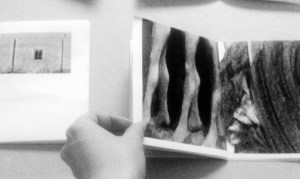
The project aims to pose questions such as:
- Where and under what conditions can book arts be displayed and distributed?
- Which are the implications of the democratic multiple as a model of art distribution?
- Is the Hybrid form “Free PDF to print” an appropriate model of distribution?
- Is it possible to use the best from both worlds, analogue and digital, in a hybrid form?
- What are the advantages and disadvantages of each, explore shifts and challenges?
Ever changing narrative
Focusing on visual narratives and engaging with forms, fe et ex provokes questions around issues of authorship by reducing, or even removing, the division between producer and consumer.
This is achieved by inviting the consumer to take part in the editing and production process, creating a collaborative process between the producer and the viewer/consumer.
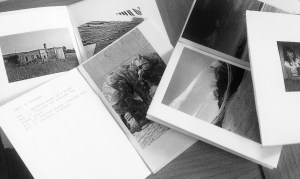
Reflecting upon the production of a stand-alone art edition and of the book as a form and a medium led me to investigate some of the issues around artist’s bookmaking with regard to uniqueness and multiplication.
Fe et ex uses publishing methods as part of everyday engagement with the work to disrupt consumer/producer relationships by experimenting with publishing platforms that can engage audiences by using digital technologies and evoke handicraft processes.
 Made and Published